Kitchen Remodel Playbook: Layouts, Cabinets, and Costs That Pay Off
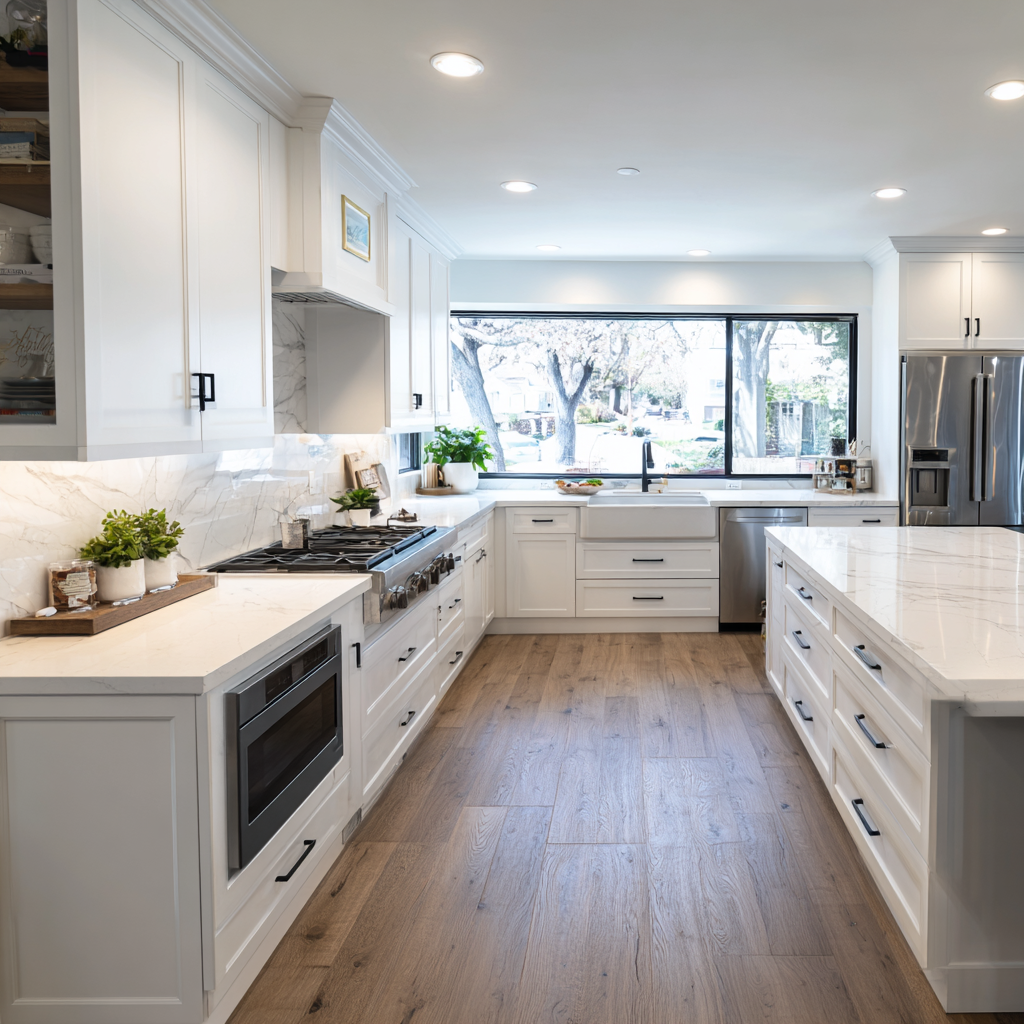
You’ll get the best return on investment by setting clear ROI targets and prioritizing minor, code-compliant upgrades (about 96% over five years) over major kitchen remodels. Keep structurally sound cabinet boxes and reface them for an 80–90% ROI ($7k–$12k), then add midrange quartz, a deep sink with a pull-down faucet, and ENERGY STAR appliances on the correct circuits. Improve flow by widening openings and shifting appliances on the same wall, not plumbing. Keep going to see the highest-impact sequence and specs.
Set Kitchen Remodel Goals and Target ROI
Because ROI drops sharply as scope expands, you’ll get the best payback by setting remodel goals around a minor, code-compliant upgrade rather than a full gut: minor kitchen remodels average 96.1% ROI over five years, while midrange major projects return about 49.5% and upscale major kitchen projects about 38.0%. Set performance targets first: safer circuits, efficient lighting, durable, cleanable surfaces, and fast “wow” optics that appraisers notice. Put dollars into cabinets via refacing, which typically returns 80–90% ROI at roughly $7,000–$12,000, instead of $15,000–$25,000 replacement. Specify midrange countertops, a water-saving faucet, and Energy Star appliances to lift perceived value without overspending. Keep a 15–20% contingency, and document permits, inspections, and clearances.
Decide What to Keep vs. Replace First
Where should you draw the keep-vs-replace line to protect ROI and stay code-compliant? Start by auditing what’s structurally sound and permitted, then spend where buyers see and touch. If your cabinet boxes are square, dry, and securely fastened, keep them and modernize the interface; refacing runs about $7,000–$12,000 and can return 80–90% ROI, compared with $15,000–$25,000 to replace. Pair that with midrange surfaces: a 40 sq ft quartz top at $3,000–$4,500 can deliver 75–85% ROI.
- Keep sound cabinet boxes; reface doors/fronts
- Replace worn hardware for a precision feel
- Upgrade countertops for durable, high-impact value
- Swap to energy-efficient appliances with correct circuits
- Update paint and lighting using code-rated fixtures
Improve Kitchen Layout Flow (Without Moving Plumbing)
How do you make a kitchen feel bigger and work better without paying for new plumbing rough-ins? Start by engineering the layout flow without moving plumbing: re-route traffic, not pipes. Widen cased openings, or remove a non-bearing wall with a properly sized header, and permit to connect to dining/living zones—open sightlines boost perceived square footage and resale appeal. Add an island as a prep-and-storage hub with code-required clearances (typically 36–42 inches of aisle space) to keep circulation unblocked. In small plans, shift appliances along the same utility wall to tighten the work triangle and keep existing supply/vent paths. Consider a peninsula when an island won’t fit; it adds seating and landing space while maintaining egress. Lock these decisions early to protect ROI.
Make Old Cabinets Look New With Refacing
A cabinet refacing plan gives you the new kitchen look while keeping the existing cabinet boxes in place, which protects budget and schedule without sacrificing resale impact. With cabinet refacing, you swap doors, drawer fronts, and hardware, then finish exposed frames for a factory-clean appearance—without triggering layout or MEP scope. Expect 80–90% ROI, typically $7,000–$12,000 versus $15,000–$25,000 for full replacement, and less landfill waste.
- Confirm boxes are plumb, square, and structurally sound
- Specify soft-close, full-overlay doors, and durable finishes
- Use concealed hinges and pulls that meet clearance needs
- Verify ventilation and fire-blocking aren’t compromised
- Price wholesale doors/parts online for cost-effective upgrades
Upgrade Countertops, Sink, and Faucet
Countertops, the sink, and the faucet drive most of your kitchen’s “value read,” so upgrading them delivers fast visual impact without expanding MEP scope or triggering permit-heavy layout changes. Specify mid-grade quartz countertops (about 40 sq ft installed for $3,000–$4,500) to replace laminate or tile, targeting 75–85% ROI, with low maintenance and tight, modern seams. Keep overhangs, support, and edge profiles within manufacturer specs, and use proper substrate and silicone for a code-compliant, sanitary assembly.
For fixtures, choose a deep single-bowl sink, a pull-down faucet with lead-free certification, and an accessible shutoff; budget $800–$1,500 and expect 85–95% ROI. Match finishes to hardware for a cohesive, high-tech look.
Add Layered Lighting and Efficient Appliances
Once you’ve locked in upgraded countertops and fixtures, set the kitchen’s “value read” with layered lighting and energy-efficient appliances that boost daily performance without kicking off permit-heavy layout work. Treat lighting as a system: meet baseline illumination with recessed LEDs, then add targeted task and decorative layers for human-centered comfort and resale polish. Keep spend disciplined—aim 5–10% of your budget on fixtures/finishes—because buyers feel lighting immediately. Under-cabinet LEDs cut countertop shadowing, improving prep safety and visibility. Pair that with high-efficiency appliances to signal modernity, lower operating costs, and reduce maintenance through longer-life components. Specify UL-listed, damp-rated where required, and install on dedicated circuits with compliant switching.
- Recessed LED general lighting
- Under-cabinet task strip
- Pendants over islands
- Dimmable controls zoning
- ENERGY STAR appliances
Avoid Scope Creep and Low-ROI Remodel Spend
While you’re dialing in finishes and fixtures, lock the scope before “nice-to-haves” snowball into a low-ROI gut job. Define performance targets: storage function, task lighting levels, and circulation clearances, then write a line-item budget with allowances and change-order rules to stop scope creep. Treat cabinet costs as your control lever: reface existing boxes for roughly $7,000–$12,000 with 80–90% ROI, instead of $15,000–$25,000 replacements that add waste and downtime. Keep layout changes surgical unless you must move plumbing or circuits to meet code. Choose mid-grade counters, efficient appliances, and compliant GFCI/AFCI upgrades for “smart” value. If a feature doesn’t improve daily use or resale comps, defer it and stage later.
Conclusion
You don’t need an Odysseus-level journey to get a “wow” kitchen—just a plan that’s permit-smart and ROI-driven. Keep sound cabinet boxes and a code-compliant layout, then reface for maximum visual lift per dollar. Choose durable mid-grade counters, a deeper sink, and a vetted faucet for measurable usability gains. Layer ceiling, under-cabinet, and task lighting to hit both lux and function. Control scope creep, and your resale numbers won’t betray you.
Frequently Asked Questions
1. What is the “Kitchen Work Triangle,” and is it still relevant in modern design?
The kitchen work triangle is a classic architectural design rule stating that the three most high-traffic elements—the refrigerator, the sink, and the cooktop—should form a clear, unobstructed triangle. Each leg of the triangle should measure between 4 and 9 feet, with the total distance not exceeding 26 feet.
While it is still highly relevant for smaller footprints, modern luxury kitchens often shift to “Zone Design.” This organizes the space into distinct functional stations (e.g., a meal prep zone, a baking zone, a cleaning station, and a coffee bar) to accommodate multiple cooks working at the same time without crossing paths.
2. What is the difference between framed and frameless cabinets?
This choice dictates both the visual style and the storage capacity of your kitchen:
- Framed Cabinets (Traditional/American): Feature a solid wood face frame attached to the front of the cabinet box. The doors attach to this frame, adding excellent structural rigidity. It gives a classic, layered look but slightly narrows the drawer opening.
- Frameless Cabinets (Modern/European): Eliminate the face frame completely. The doors attach directly to the sides of the cabinet box, offering a sleek, flush appearance. Because there is no frame overhanging the interior, you get maximum interior drawer width and easier access to storage space.
3. Why should I choose custom cabinets over stock big-box store cabinets?
While stock cabinets are cheaper upfront, they come in rigid 3-inch size increments. If your kitchen wall measures 104 inches, a stock installer will have to use standard 90-inch or 96-inch cabinet combinations and hide the remaining space with wide, useless filler strips of wood.
Custom cabinets are engineered to the exact millimeter of your room’s blueprint. This eliminates dead space, maximizes your storage, and allows for furniture-grade wood construction (like maple or walnut boxes with solid dovetail joints) instead of cheap, stapled particleboard that sags under the weight of heavy dishware.
4. What are the pros and cons of an open-concept kitchen layout?
- The Pros: It completely transforms the flow of your home, allowing the cook to interact with guests in the living room, maximizing natural light, and making a modest floor plan feel expansive.
- The Cons: It requires removing walls, which often means installing expensive structural steel headers to hold up the second floor. It also means your kitchen mess is always on full display from the couch, and cooking odors and appliance noise travel freely throughout the main level.
5. How much of my total home value should I spend on a kitchen remodel?
A safe real estate thumb rule is the 10% to 15% rule. Your kitchen remodel budget should typically sit between 10% and 15% of your home’s total overall market value. Spending less than 5% might result in materials that feel cheap and depress your home’s appeal, while spending greater than 20% makes it incredibly difficult to recoup your investment when you eventually sell.
6. What are the smartest ways to save money during a kitchen remodel without cutting quality?
To keep your budget tight without compromising structural integrity:
- Keep the existing plumbing layout: Shifting a sink or dishwasher even 3 feet requires tearing up flooring or subfloors to reroute heavy drain lines and vent stacks, quickly adding thousands to plumbing bills.
- Keep your structural walls intact: Work within your kitchen’s current physical footprint rather than tearing down load-bearing walls that require major structural beam engineering.
- Choose open shelving accents: Mixing in a few custom floating wood shelves instead of a continuous run of heavy upper wall cabinets cuts material costs while creating a trendy, airy aesthetic.
7. What type of lighting plan does a functional kitchen require?
A premium kitchen requires a “layered” lighting approach spanning three distinct categories:
- Ambient Lighting: Recessed LED ceiling lights spaced evenly across the entire room to provide uniform, general brightness.
- Task Lighting: Highly targeted illumination where the actual work happens. This includes bright under-cabinet LED tape lighting to illuminate countertops for safe knife prep, and direct pendant fixtures hanging over the island.
- Accent Lighting: Low-voltage lighting used purely for architectural drama, such as soft interior cabinet lighting behind glass doors or toe-kick lighting beneath the base cabinets.
8. Which countertop material offers the best balance of luxury and durability?
While marble looks stunning, it is highly porous and will permanently stain the moment red wine or lemon juice sits on it. For the best combination of aesthetics and durability, choose engineered quartz or high-grade quartzite. Quartz is entirely non-porous, resists scratching, and never requires routine sealing. If you want 100% natural stone that can handle screaming-hot pans straight off the stove, choose a dense granite or soapstone.
9. What hidden code requirements must I plan for regarding kitchen electricity?
Modern building codes have incredibly strict safety rules for kitchens due to the mix of water and high-powered appliances:
- GFCI Protection: All countertop receptacles must be Ground Fault Circuit Interrupter (GFCI) protected to prevent electrical shocks near water sources.
- Dedicated Circuits: High-draw appliances—like the refrigerator, dishwasher, microwave, and garbage disposal—must each sit on their own independent, dedicated circuit breaker back at the main panel so you don’t trip the power when cooking.
- Countertop Spacing: Receptacles must be placed along countertops so that no point along the wall is further than 24 inches from an outlet.
10. How long does a total kitchen remodel take from demolition to completion?
A realistic timeline for a full, down-to-the-studs kitchen transformation spans 6 to 10 weeks of active construction. This timeline is heavily dictated by material lead times. For instance, after your new cabinet boxes are permanently installed, a template crew must measure the stone countertops to the exact fraction of an inch. Fabricating that custom stone slab typically takes 2 weeks, during which major carpentry work pauses until the stone is set and plumbing fixtures can be hooked up.