How to Choose the Right Contractor for Your New Home Build

You choose the right home building contractor by first setting an all-in budget and a one-page brief of must-haves, nonnegotiables, and decision deadlines. Match the builder type (production, custom, design-build, hybrid) to your risk tolerance and design needs. Verify licenses, permits, insurance, and bonding before bidding. Interview for a critical-path schedule, lead times, and change-order rules. Compare bids line by line for allowances, exclusions, and specs. Next, you’ll see how to confirm references and contracts.
Set Your New Home Goals and Budget
Where do you want to land on move-in day—size, layout, finishes, and a firm all-in price? Lock those targets before you call anyone, because they drive scope, schedule, and risk. Start with a one-page brief: must-haves, nice-to-haves, and nonnegotiables for energy performance, smart-home infrastructure, and future expansion. That’s goal prioritization, and it prevents design drift.
Next, build budget alignment with a realistic all-in number: land prep, permitting, utilities, design fees, insurance, contingencies, and escalation. Set decision deadlines for key selections (foundation, windows, and mechanicals) to avoid lead times from derailing your timeline. Define your change-order rules upfront: who approves, how pricing is validated, and how schedule impacts get logged.
Choose the Right New-Home Builder Type
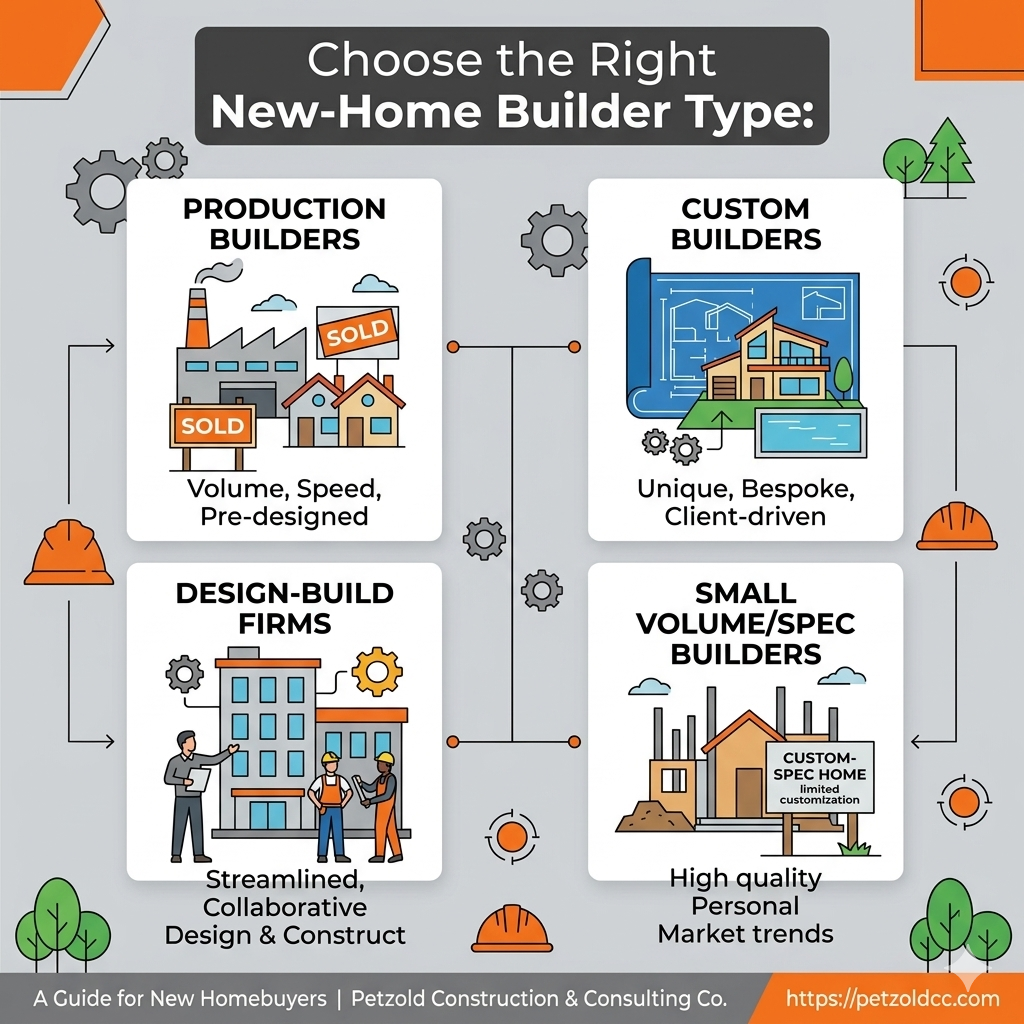
How do you keep cost, timeline, and quality from drifting once new construction starts? You choose a builder type that matches your delivery model and risk tolerance. A production builder excels at repeatable systems, predictable schedules, and tight allowances, but you’ll face clearer budget tradeoffs on upgrades. A custom builder gives you design freedom and tighter integration with your architect, yet you must manage more change-order risk and longer lead times. A design-build firm compresses handoffs, resolves clashes early with BIM, and can lock milestones sooner—ideal if you want innovation with fewer coordination gaps. A hybrid contractor-manager offers transparency and vendor flexibility, but you’ll own more procurement risk. Prioritize documented processes, not promises, and verify energy efficiency performance targets.
Where to Find Reputable New Home Contractors
Often, the fastest way to find a reputable new-home contractor is to start with sources that leave a paper trail and filter for performance, not popularity. Begin with your local building department’s permit records and inspection schedules to see who’s actively delivering compliant projects on time. Use your state licensing board and trade associations to shortlist contractors with current credentials and clean insurance filings. Ask your architect, structural engineer, or energy consultant for builders who execute tight scopes, modern assemblies, and high-performance details without change-order chaos. Visit active subdivisions and custom builds, then note crew organization, site safety controls, and how materials are protected from weather. Finally, use procurement platforms that log bids, RFIs, and timelines; they simplify reputation checks and keep your prequalification process auditable.
Check Reviews, References, and Complaint History
Before you lock in a contractor and your build schedule, you need proof that they deliver on time and fix issues fast. Verify online ratings across multiple sites, then call past references and ask specific questions about timelines, change orders, and punch-list closeout. Finally, check complaint records with your state licensing board, the BBB, and local courts to avoid inheriting unresolved disputes.
Verify Online Ratings
Where should you start when you’ve narrowed your shortlist to a few builders? You verify online ratings across multiple platforms, not just one, to stress-test their online reputation. Look for consistent patterns in timeliness, change-order handling, warranty response, and site cleanliness—schedule and risk signals that matter on a new build. Sort reviews by newest to confirm current crews and processes, then scan the lowest ratings for recurring root causes, not one-off emotion. Validate reviewer credibility: detailed scope notes, photos, and location context beat vague praise. Check for rating spikes that suggest paid campaigns. Finally, review complaint histories with state licensing boards, consumer agencies, and court records to spot liens, disputes, or permit issues that could derail your critical path.
Contact Past References
How do you confirm the five-star story matches real job-site performance? You call recent clients and run tight references validation. Ask for start-to-finish dates, change-order frequency, and whether milestones are held without constant prodding. Request photos, punch-list records, and permit sign-off timing so you can map their timeline against yours. Probe communication cadence: did they reply within a day, log decisions, and surface risks early?
Go beyond curated names: ask for one project that hit snags, and learn how they redesigned, value-engineered, or re-sequenced trades to protect the schedule. Capture past project insights on subs, site cleanliness, safety routines, and warranty follow-through. Then compare answers across at least three references for consistency and measurable outcomes.
Check Complaint Records
Ever wonder what a builder’s sales pitch leaves out? Before you sign, audit complaint records like you’d audit a project schedule. Start with your state licensing board and local consumer agencies; note case dates, outcomes, and repeat patterns. Cross-check with BBB files and online reviews, but filter out noise—one rant about an unrelated topic or an irrelevant focus (like parking) won’t predict build quality. You’re hunting systemic risks: missed inspections, change-order disputes, lien claims, warranty refusals, or abandoned jobs. Ask the contractor for written explanations and corrective actions, then verify them against the documentation. If complaints cluster in the last 12–24 months, treat it as a timeline hazard. Build a go/no-go threshold and stick to it.
Confirm Licenses, Insurance, and Bonding
Before you sign and lock in start dates, confirm your contractor’s license is current and that they’ll pull the required permits for your build. Ask for up-to-date certificates for general liability and workers’ comp, and verify policy limits and expiration dates with the insurer. Make sure bonding is in place as required, because it reduces your exposure if deadlines slip or work doesn’t meet contract terms.
Verify License And Permits
When should you verify a contractor’s license and permits—at bid time, not after framing starts—because missing credentials can halt inspections, void warranties, and trigger costly change orders. Ask for the license number, exact legal business name, and trade classification, then confirm status and disciplinary history in your state’s portal to ensure it meets local licensing standards. Match the license scope to your build’s complexity (custom structural work, energy systems, smart-home integration), so you’re not funding out-of-scope labor. Next, map permits to your critical path: grading, foundation, utilities, framing, electrical, mechanical, plumbing, solar, and occupancy. Require a permitting matrix with owners, submission dates, review durations, and re-submittal buffers. Verify permits are posted, and inspection sign-offs are logged daily.
Check Insurance And Bonding
Licenses and permits keep the job legal; insurance and bonding keep a setback from turning into your financial problem. Before you sign, you’ll verify coverage dates align with your build schedule and that limits match your project’s complexity, from smart-home wiring to high-performance envelopes. Ask for certificates sent directly from the carrier, not screenshots, and confirm they’re active through move-in. Run quick insurance audits to catch exclusions, lapsed premiums, or missing additional-insured language. Then confirm the bond type and amount, and make sure it covers subcontractors and lien risks—bonding lapses can freeze progress and trigger change orders. Put verification checkpoints on your timeline and recheck at major milestones.
- General liability policy and limits
- Workers’ comp for every crew
- Builder’s risk requirements and endorsements
- Performance/payment bond confirmation
Review Portfolios for Similar New Builds
How do you know a contractor can deliver the kind of new home you’re planning—on time and without costly surprises? Start with portfolio reviews that match your scope: custom, semi-custom, or design-build, plus similar lot constraints and climate. Look for consistent build aesthetics across exterior lines, interior detailing, and material transitions, not one-off showpieces. Ask for project timelines and compare start-to-close durations across several builds to gauge schedule discipline. Verify they’ve executed innovations you want—high-performance envelopes, smart-home integration, prefab components, or low-carbon materials—without quality drift. Review photos and, if possible, walkthrough videos to spot workmanship: tight reveals, aligned grout, clean MEP routing. Favor portfolios showing repeatable systems and documented milestones over flashy renderings alone.
Interview Builders: Questions That Spot Red Flags
Where do interview answers start to reveal schedule risk and budget volatility? When you interview builders, listen for how they model unknowns, not how confidently they promise dates. Ask for their critical-path plan, lead-time assumptions, and how they’ll protect milestones when inspections slip or materials spike. Push for data: recent cycle times, change-order triggers, and escalation clauses. Innovative builders will show dashboards, weekly look-aheads, and clear decision gates; vague talk is one of the fastest red flags.
- “What’s your process for tracking schedule variance week to week?”
- “Which trades are in-house vs. subcontracted, and what’s your backup plan?”
- “How do you price and approve changes before work starts?”
- “Who owns procurement, and how do you handle long-lead items?”
Compare New Home Builder Bids Line by Line
A clean bid comparison starts with standardizing every line item so you’re not comparing a low allowance to a fixed price—or a short schedule to an unrealistic one. Request the same scope template from each builder: sitework, foundation, framing, MEPs, insulation, finishes, permits, and cleanup. Then verify quantities, brands, model numbers, and performance specs so “equivalent” doesn’t hide substitutions. Flag exclusions, alternates, and owner-supplied items, and price them yourself to expose pricing gaps. Scrutinize allowances: are they realistic for your design targets, or engineered to win on paper? Map each cost to risk—soil unknowns, utility tie-ins, and change-order markups. Finally, align warranty expectations in writing: coverage, transferability, response times, and what voids it.
How Your Builder Handles Schedules and Delays
You should ask your builder to show you their scheduling process, including a milestone-by-milestone timeline tied to permits, trade sequencing, and inspections. You’ll also want clear visibility into likely delay causes—weather, material lead times, subcontractor availability—and exactly how they’ll report impacts to the critical path. Finally, confirm they’ve got contingency plans and a communication cadence in place so you’re not surprised when the schedule shifts.
Scheduling Process And Milestones
How does a builder keep your home build on track when weather, inspections, and material lead times start shifting the calendar? You ask for a milestone-based schedule tied to budget planning and risk management, not vague date ranges. Your builder should map each phase to clear entry/exit criteria and use modern scheduling tools to show dependencies, float, and critical path. You’ll make faster decisions because you’ll see what’s next and what’s blocked.
- A baseline schedule with weekly look-aheads and owner decision deadlines
- Milestones: permit release, foundation pour, dried-in shell, rough-ins, insulation, final punch
- Trade sequencing that prevents stacking crews and rework
- Change-order integration that updates dates, procurement, and inspections automatically
Delay Causes And Transparency
When do “minor” slips become real schedule risk—after the first weather day, the first failed inspection, or the first backordered window package? You should expect your builder to name the causes of delays in measurable terms, not vague excuses. Ask for a critical-path schedule that shows float, lead times, and inspection windows, then see how they track variance week to week. Good delays transparency means you can trace each slip to a dependency: material procurement, trade sequencing, plan revisions, or utility tie-ins. You’ll also want a clear rule for when schedule compression triggers premium labor or expedited freight, because that’s where cost overruns start. If they can’t quantify impacts in days and dollars, you’re absorbing unmanaged risk.
Contingency Plans And Communication
Where does the schedule go the moment a crew no-shows, an inspection fails, or a key material shipment slips? You want a builder who protects your critical path with contingency planning, not excuses. Ask how they re-sequence tasks, lock alternates, and quantify float so decisions stay data-driven. Just as important, demand a communication strategy that’s proactive, time-stamped, and shared in a single source of truth.
- Daily log updates with photos, blockers, and next-day commitments
- Look-ahead schedules (2–6 weeks) with risk flags and owners
- Preapproved substitutes and backup trades to prevent idle days
- Escalation rules: when you’re called, what options you get, and by when
If they can’t show templates and response times, your timeline’s already at risk.
Get the Build Contract and Communication Plan in Writing
A solid build contract and a written communication plan protect your schedule and budget by removing guesswork before work begins. Lock down the contract scope: inclusions, exclusions, allowances, and who owns permitting, inspections, and utility coordination. Define change-order workflow with pricing rules, approval turnaround, and schedule impacts so surprises don’t derail milestones. Confirm payment terms tied to verified progress, not calendar dates, and require lien waivers at each draw.
Put communication in writing, too: meeting cadence, decision deadlines, and a single source of truth (shared dashboard, logs, and photos). Specify response times, escalation steps, and how RFIs get tracked. Set deliverable dates for selections and shop drawings, and require weekly schedule updates with risk flags and recovery plans.
Frequently Asked Questions
How Do Change Orders Affect the Final Price and Timeline?
Change orders raise your final price and can push your schedule because you’re altering scoped work midstream. You’ll see timeline impact from re-approvals, rework, and trade rescheduling, especially with materials changes and lead times. Budgeting implications include increased labor, restocking fees, lost productivity, and contingency drawdowns. You’ll reduce risk by documenting each change fast, locking pricing, and syncing updates to your critical path. Use digital tracking dashboards.
Who Owns the Architectural Plans, and Can I Reuse Them Later?
Plans’ proprietary power usually stays with the architect unless your contract assigns ownership; you must verify who owns the plans. You can reuse them only if your agreement grants rights, since licensing restrictions often limit copying, adapting, or building elsewhere. To gauge reuse feasibility, confirm copyright, seal requirements, and jurisdiction rules early, then schedule approvals, revisions, and permit resubmittals. Mitigate risk by negotiating a reuse license, scope, and fees upfront.
What Warranties Cover Workmanship, Materials, and Structural Issues After Move-In?
After move-in, you’ll typically rely on three warranties: a workmanship warranty (often 1 year) for installation defects, a materials warranty (manufacturer-backed, varies by product) for failures, and a structural warranty (often 10 years) for major load-bearing issues. Confirm warranty coverage in writing before closing, log post-move-in issues within the required notice windows, and schedule inspections at 30/90/365 days. Escalate claims fast to avoid waiver.
Will the Builder Manage Permits, Inspections, and Utility Hookups End-To-End?
Like a pilot running a preflight checklist, you’ll want the builder to manage permits, inspections, and utility hookups end-to-end—and you should require it in writing. You’ll confirm permitting responsibilities: who prepares drawings, files applications, pays fees, and tracks approvals. You’ll also verify utility coordination: power, water, sewer, gas, and telecom schedules, trenching, meters, and turn-ons. You’ll demand milestone dates, inspection calendars, contingency buffers, and escalation paths.
How Are Subcontractors Selected, Paid, and Supervised on My Project?
You’ll define subcontractor selection criteria upfront: vetted licenses, safety record, capacity, and past performance, then lock them in via scoped bid packages. You’ll tie payment supervision to milestones, lien waivers, and verified field progress, not estimates. You’ll supervise subs through daily look-aheads, digital task boards, QA checklists, and photo logs, so you can escalate issues quickly. You’ll require schedule commitments, contingency plans, and clear change-order rules to reduce delays and cost creep.
Conclusion
Choosing the right contractor is like picking the captain for your ship before you leave the dock. You’ve set your course with clear goals and a firm budget, checked their credentials like a compass, and read reviews like weather reports. You’ve grilled them for red flags, compared bids plank by plank, and mapped schedules for storms and delays. Now lock it all in—contract, timelines, check-ins—so your build reaches shore on time.
Frequently Asked Questions
Here are 10 consumer-focused FAQs tailored to the highly critical process of vetting and choosing the right contractor for a new custom home build. They are written in an honest, supportive tone designed to build client trust while highlighting the high-level professional standards of a premium builder.
1. Why is choosing a custom home builder different from hiring a standard remodeling contractor?
A remodel typically keeps you tied to an existing structure and can take a few weeks to months. Building a new custom home from scratch is a massive, multifaceted operation that spans over a year. Your custom builder acts as a project manager, a structural consultant, and a financial coordinator all at once. They must possess advanced expertise in raw site excavation, civil engineering, zoning board navigation, foundation mechanics, and complex whole-house HVAC integration.
2. What is the difference between a “Fixed-Price” contract and a “Cost-Plus” contract?
These are the two main ways a custom home build is financed:
- Fixed-Price (Lump Sum): The builder gives you a single, firm total price for the entire scope of work based on your blueprints. If material costs spike unexpectedly, the builder absorbs the loss; if they finish under budget, they retain the savings. This offers maximum budget predictability for the homeowner.
- Cost-Plus: You pay for the actual, raw cost of all materials and subcontractor labor, plus a fixed percentage fee (typically 12% to 20%) to the general contractor for managing the build. This offers total transparency, but requires a highly flexible budget.
3. What are “allowances” in a construction contract, and how can they ruin my budget?
An allowance is a specific financial buffer built into your contract for items that haven’t been selected yet (e.g., “$10,000 for kitchen appliances” or “$5 per square foot for tile”). Cut-rate contractors intentionally input artificially low allowances to make their initial bid look incredibly cheap. Once you go to select actual high-end materials, you quickly blast past those low allowances, resulting in massive out-of-pocket price increases. A quality builder uses realistic, market-accurate allowances based on your true design goals.
4. How do I verify a builder’s true reputation beyond online reviews?
Online reviews can be faked or curated. To vet a high-end custom home builder properly, ask them for the contact information of three clients who completed homes with them over two years ago. Speaking with past clients who have lived in their homes for a couple of winters will tell you exactly how well the structural framing settles, how responsive the builder is to warranty items, and what the contractor was really like to work with day to day.
5. Should I hire an architect first, or choose my custom builder first?
While you can hire an architect first, the modern gold standard is the Design-Build approach, which brings your builder to the table during the initial architectural drafting phase. Architects are masters of aesthetics, but they don’t buy two-by-fours every day. If you design blueprints in a vacuum, you risk creating a beautiful home that costs twice your actual budget to build. Having a builder collaborate with your architect from day one ensures that every design choice is instantly cross-referenced with real-world material costs and labor realities.
6. What is a “Change Order,” and how should a professional builder handle them?
A change order is an official, written amendment to your initial construction contract. It occurs whenever you request a structural change, an appliance upgrade, or a design pivot after construction has already kicked off. A professional builder will never perform extra work and surprise you with an invoice at the end of the month. Every single change order should be documented in writing, detailing the exact modification, the precise material shift, and the signature of both parties before any labor begins.
7. How does a custom builder handle the permitting and zoning process?
Navigating local town hall departments can be a logistical nightmare for a homeowner. A professional general contractor handles this entirely on your behalf. They pull the primary building permits using their professional license, submit the necessary structural engineering calculations, coordinate with local conservation commissions, and handle state environmental approvals (like NHDES septic review or MA Title 5). This keeps the legal accountability entirely on the builder’s shoulders.
8. Who actually builds my home—the contractor’s crew or independent subcontractors?
A premium custom build relies on a strategic blend of both:
- In-House Carpenters: Handle the core artisan work, such as framing, structural roof ties, architectural trim, and fine interior millwork where precision is paramount.
- Specialized Subcontractors: Licensed masters of the mechanical trades (plumbers, HVAC technicians, electricians, and excavation crews) who focus exclusively on installing code-compliant systems under the general contractor’s daily supervision.
9. What happens if material prices spike or supply chain delays occur mid-build?
A detailed construction contract should explicitly include a Material Escalation Clause and a Force Majeure outline. These clauses protect both parties by dictating exactly what happens if unprecedented market volatility occurs. A transparent builder mitigates these risks by pre-ordering and warehousing long-lead materials (such as custom windows, roofing trusses, and major appliances) months in advance to lock in pricing and keep building timelines on schedule.
10. What kind of warranty should a custom home builder provide after completion?
A standard handshake is not a warranty. A professional custom builder provides a formal, comprehensive written warranty document at closing. This typically breaks down into tiered protections:
- 1 Year: Comprehensive coverage covering fit-and-finish elements (drywall nail pops, minor trim adjustments, door alignments as the house naturally settles).
- 2 Years: Coverage for mechanical delivery systems (underlying plumbing, electrical lines, and HVAC ductwork performance).
- 10 Years: Structural warranty covering the absolute structural integrity of the foundation, load-bearing walls, and roof trusses.